Career Advice
How to Write an ATS-Proof Software Engineer Resume in 2026
Adam Ross ·

At some point in your job search, someone told you a robot reads your resume and bins three quarters of them before a human ever looks. It might have been a TikTok, a career coach, or a resume-scanner ad. The number is usually 75 percent, and it has never had a study behind it.
Here's what's actually true, and it's worse in a different way: the ATS almost never rejects your resume. It just never surfaces it. An applicant tracking system is a database that recruiters search. If your resume parsed badly or doesn't contain the words a recruiter types into that search box, you weren't rejected. You were never found. Silence, not a verdict.
That distinction changes everything about how you should write the document. You're not optimizing against a rejection bot. You're optimizing for retrieval: being findable in a search, skimmable in a ranked list, and credible in the eight seconds a human spends deciding whether to keep reading.
This guide covers how the machine actually works, then the format, keyword, and bullet decisions that follow from it.
Does the ATS actually reject your resume?
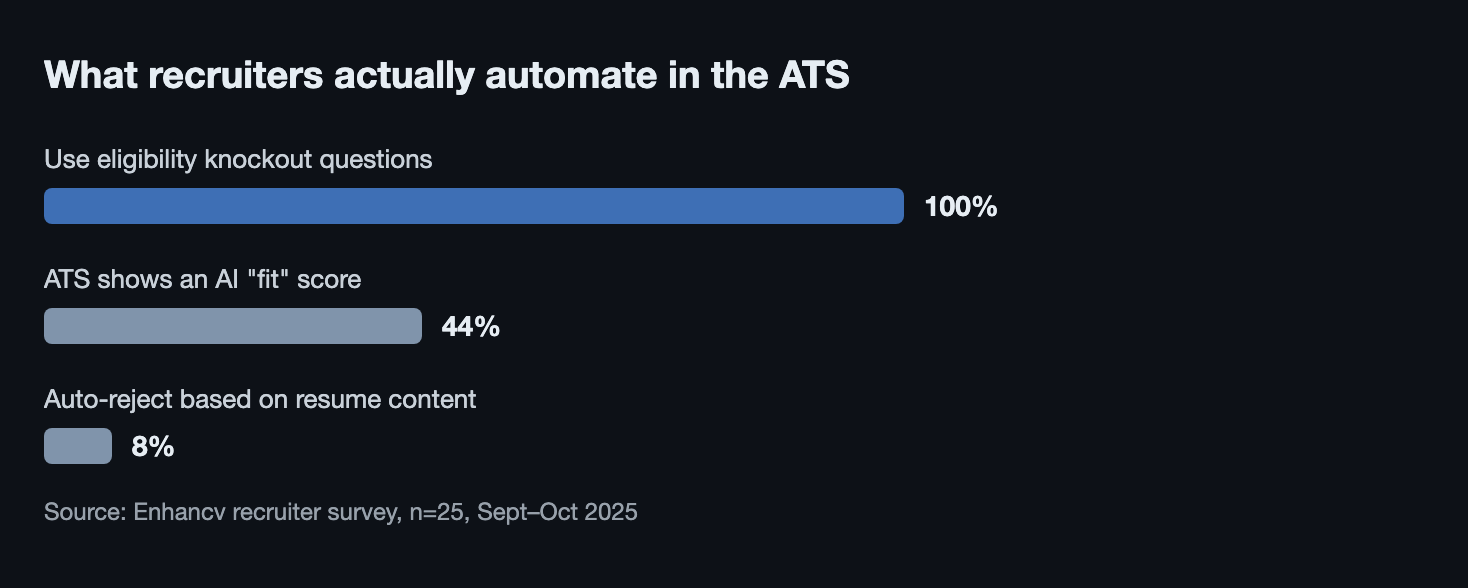
Almost never for its content. Enhancv surveyed 25 US recruiters across tech, healthcare, and finance in September and October 2025 and asked them directly. 92 percent said their systems do not auto-reject resumes for formatting, content, or design. Only 2 of the 25 had content-based auto-rejection configured at all.
What every single one of them does automate is the eligibility knockout, which we'll get to in a second.
As for the famous 75 percent claim: career-research writers who went digging traced it to a 2012 sales pitch from a resume-optimization vendor that shut down the following year. In the Enhancv survey, recruiters were asked where candidates get the idea; 68 percent pointed to LinkedIn and TikTok.
So the resume-scanner industry has been selling you protection from a bot that, in 92 percent of shops, doesn't exist. What exists instead is a search box and a tired human. Write for those.
What actually filters you out automatically?
Knockout questions. 100 percent of the surveyed recruiters use them, and 84 percent rely on them specifically for work authorization, certifications, or location.
These are the yes/no questions bolted onto the application: Are you authorized to work in the US? Do you hold an active clearance? Are you within commuting distance? Answer on the wrong side of a hard requirement and the application closes out, regardless of how good the resume is.
Two practical rules follow:
→ Answer them honestly. A knockout is binary and usually verified later. Gaming your way past one buys you interviews for a role you can't legally or practically take.
→ If a knockout excludes you, that application was never viable. The listing wasn't lying to you; the pipeline just wasn't yours. Spend the hour on a posting where you clear the bar.
How do recruiters actually find your resume in an ATS?
They search it like a database, because it is one. A recruiter working a role with 800 applicants doesn't read 800 resumes top to bottom. They search by title, by skill, by company, sometimes with full boolean strings, then read the first handful of results that look right and build a shortlist.
Three consequences for how you write:
- Exact strings matter. The search is mostly literal. If the recruiter types "Kubernetes" and your resume only says "container orchestration," you don't come up.
- Parsed fields are searchable fields. When your resume imports, the ATS parses it into structured data: titles, companies, dates, skills. Anything that fails to parse (a skill trapped inside a table, a title inside a graphic) may as well not be on the page.
- The skim is ranked and shallow. Coming up in search gets you a glance, not a read. The top third of page one decides whether the glance continues.
What resume format parses cleanly?
Boring format, sharp content. Every formatting decision below exists to survive the parser and speed up the skim:
→ Single column, reverse-chronological. Multi-column layouts and sidebars are the number-one parsing casualty.
→ Standard section headings. "Experience," "Skills," "Education," "Projects." Parsers key on these words. "Where I've Made Impact" confuses machines and mildly annoys humans.
→ No tables, text boxes, icons, or graphics. Skill-rating dots and logo strips parse as noise or nothing.
→ Contact info in the document body, not in a header or footer; some parsers skip those regions entirely. Name, city, email, phone, GitHub and LinkedIn as plain-text URLs.
→ Text-based PDF or .docx. Test yours: select-all, copy, paste into a text editor. If what comes out is readable and in order, a parser will manage. If it's scrambled or empty, fix the export.
→ Plain date formats. "Jan 2023 - Present." Parsers use these to compute your years of experience; ambiguous dates can quietly zero that field.
None of this wins you the job. It just guarantees the machine indexes everything you wrote, so the search can find it and the human can skim it.
Which keywords matter for a software engineer?
The ones in the job description, in the job description's own words. Not because a bot scores you, but because those are the words the recruiter will type into the search box, and the words their eyes will scan for in the ranked list.
For an engineering resume that means:
→ Languages, frameworks, and infrastructure by exact name. Cover the alias problem inline: "Go (Golang)," "Kubernetes (k8s)," "AWS (Lambda, ECS, RDS)." You don't know which variant gets searched, so carry both.
→ A Skills section that works as an index: 8 to 12 technologies you could interview on tomorrow, ordered by relevance to the role you're targeting. Not 40. A recruiter reads a 40-item skills wall as zero information.
→ Evidence in the bullets for every skill you list. The skills line gets you retrieved; the bullet that shows you shipping with that skill gets you shortlisted. A listed skill with no supporting bullet is a liability in the first phone screen.
→ Searchable titles. "Senior Software Engineer, Payments" is a search hit. If your internal title was something nonstandard, translate it and keep the real one in parentheses.
How should you write the bullets?
Mechanism plus number. What you built, with what, and the measurable consequence. That structure survives every reader you have: the parser indexes the nouns, the skimming recruiter catches the number, the hiring manager sees the engineering judgment.
Weak: "Responsible for improving API performance."
Strong: "Cut p95 latency on the orders API from 900ms to 210ms by moving hot-path reads to a Redis cache and killing N+1 queries; checkout conversion rose 3%."
Weak: "Leveraged AI tools to increase team productivity."
Strong: "Built the team's CI review-bot on Claude's API; it now catches ~30% of style and null-safety issues before human review, cutting median PR turnaround from 2 days to 1."
Three to five bullets for recent roles, one or two for old ones. And write them yourself, in your own words. Recruiters in 2026 see hundreds of resumes with the same generated cadence ("spearheaded," "leveraged," "results-driven"), and a growing number say they discount them on sight. Specific numbers, real system names, and slightly imperfect human phrasing are what credibility looks like now.
Should you tailor for every application?
Yes, and it takes ten minutes when you scope it correctly. Full rewrites per application are a myth nobody sustains. Scoped tailoring is three moves:
- Match your headline/title line to the role's language.
- Reorder the Skills section so the JD's top requirements appear first.
- Swap or re-angle two or three bullets so the most relevant evidence sits in the top third of page one.
The trap is arithmetic: tailoring times volume. Nobody hand-tailors 150 applications, which is how most people end up firing the same untailored resume everywhere and losing every keyword search. You get out of that trap with fewer, fresher, tailored applications, or by automating the scoped-tailoring loop; that loop is exactly the part we built ApplyIn to run. Either way, the principle holds: ten tailored applications to postings a day old beat a hundred identical ones into the void.
Do AI screeners change any of this in 2026?
Less than the panic suggests. In the same 2025 survey, 44 percent of recruiters said their ATS shows an AI or "fit" score, but only 8 percent let it decide anything; 36 percent treat it as a guide and check candidates manually.
Where LLM-based screening is real, it behaves like a very fast version of the human skim: it rewards concrete evidence, coherent chronology, and language that matches the role, and it's increasingly tuned to flag generated boilerplate. Which means the same resume wins both screens. There is no separate "AI optimization" step, and anyone selling you one is running the 2012 playbook with a new villain.
FAQ
Should a software engineer resume be one page or two?
Under roughly five years of experience, one page. Past that, two pages are fine and often better than a compressed one, with the rule that page one must stand alone: if the reader stops there, they've seen your strongest case.
PDF or Word?
Text-based PDF, unless the posting explicitly asks for .docx. The copy-paste test above settles whether yours is parseable. Never export a resume as an image-based PDF from a design tool.
Do side projects belong on an experienced engineer's resume?
Only when they're evidence for a skill your day job can't show, like a language or domain you're pivoting toward. One or two, with plain-text repo links and the same mechanism-plus-number bullets. Cut the tutorial-follow projects.
Do I need a summary section?
Two lines, maximum: title, years, core stack, domain. "Senior backend engineer, 8 years, Go/Postgres/AWS, payments and ledger systems." It orients the human skim and front-loads search terms. Objective statements about your passion for scalable systems are filler; delete them.
The reframe worth keeping: you were never losing to a rejection robot. You were losing to a retrieval problem, a thousand-deep pile, and a search box you weren't writing for. Parse-clean format, the JD's own keywords, bullets with mechanisms and numbers, scoped tailoring. That's the whole game, and every piece of it is in your control.