Career Advice
State of the Dev Job Market 2026: Is It Actually Recovering?
Adam Ross · Mon Jun 29 2026

If you've been applying for software roles this year, you've probably felt two contradictory things at once.
The headlines say US tech is hiring again. Your inbox says otherwise.
Both are true. That's the whole story of 2026. Once you see the shape of it, the job hunt stops feeling like a personal failure and starts looking like a market you can actually navigate.
Let me lay out what's really happening, with the numbers, and then get practical about what to do with it.
The market is bigger and harder at the same time
In April 2026, U.S. job openings climbed to 7.6 million, the highest level since May 2024, while hires fell to 5.1 million. By the raw count, this is a recovery.
But in the same stretch, tech employers announced about 52,000 job cuts in the first quarter alone, and over 142,000 through May, one of the heaviest starts to a year since 2023. Hiring near a multi-year high. Firing near a multi-year high. Same quarter.
That contradiction isn't noise. It's the signal. Companies aren't hiring less. They're hiring differently. They're cutting one kind of role and racing to fill another, and the gap between those two kinds of roles is the most important thing happening in tech employment right now.
Where the openings actually went
Here's the split, in the numbers that matter:
- New grads now make up just ~7% of US Big Tech hires, down from 15% before the pandemic, and under 6% of startup hires, down from roughly 30% in 2019.
- New-grad hiring at the 15 largest tech firms is down more than 50% since 2019, and entry-level software postings are off roughly 28% from their 2022 peak.
- Employment for developers aged 22 to 25 fell nearly 20% since 2024, concentrated in exactly the boilerplate coding and routine bug-fixing that AI tools now absorb.
- Meanwhile, senior and AI-adjacent demand stayed resilient. AI was the single most-cited reason for cuts month after month, yet the same companies kept bidding for engineers who can ship AI into production.
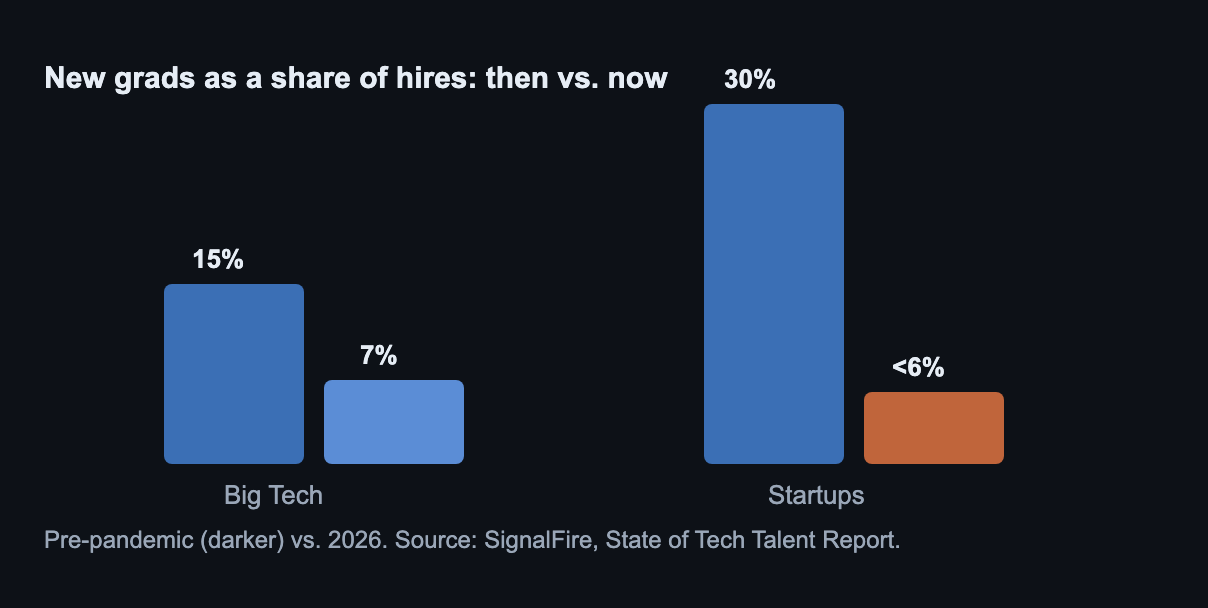
Put it together and the picture is sharp. The openings are concentrating at the senior end and around AI, while the bottom of the ladder is being quietly sawed off. The market didn't shrink. It got picky about what it pays for.
So when an early-career engineer hears "tech is hiring again" and then sends 200 applications into silence, they're not imagining things, and they're not unqualified. The openings are real. They're just not where most of the applicants are standing.
Why this is happening (it's not just layoffs)
Two forces are driving the split, and AI is underneath both.
First, AI tools now do a lot of what a junior engineer used to do. Reading a repo, writing the tests, producing a multi-file pull request, the routine, well-specified work that used to be how juniors earned their keep and learned the craft. When a tool does that for the price of a subscription, the economic case for hiring a row of juniors weakens. Companies respond by hiring fewer of them and leaning on a smaller number of senior engineers who can direct the tools.
Second, the bar for "valuable" moved up the stack. The work that's hard to automate, deciding what to build, owning whether it actually works in production, untangling ambiguous requirements, the architecture conversations that are really just talking to people, is exactly what's in demand. Companies want engineers who can operate autonomously with AI, not engineers who compete against it on raw code output.
There's a real long-term problem buried in this, and it's worth saying out loud. If juniors can't get in, the pipeline that produces the next decade's seniors breaks. We're optimizing entry-level roles out of existence and we'll act surprised by a "talent shortage" in five years. But that's a systemic issue for the industry to reckon with. If you're job-hunting today, you need to play the board as it is.
What this means for you, depending on where you stand
If you're early-career or a recent grad: The hard truth is that the door narrowed after you walked through school. That's not on you. CS grads faced roughly 6.1% unemployment in 2026, above the rate for early-career grads overall, even while CS still paid one of the highest starting salaries. The move isn't to apply to more junior reqs that barely exist. It's to make yourself legible as someone with senior-level judgment, even without the title.
If you're mid-level: You're in the most defensible spot, but don't coast. The fastest way to get cut in a pickier market is to be the person whose value is writing code an AI can now write. The fastest way to get promoted is to be the one who decides what gets built and owns the outcome.
If you're senior: Demand for you is genuinely strong. Senior postings are the part of the market that's growing, and engineers with current cloud or security experience are reportedly closing offers in weeks. The risk isn't employment. It's complacency. Don't become the cautionary tale about senior engineers who stopped thinking for themselves.
How to get on the growing side of the split
This is the part that matters. Five concrete moves:
1. Prove senior-level judgment before you have the title. The market is paying for people who can own outcomes. Ship a real project that made a real decision, and write up why you chose what you chose, what you traded off, what broke. Judgment is the scarce skill now, and it's demonstrable.
2. Become the person who directs AI, not the one who competes with it. "I'm fast at writing code" is a depreciating asset. "I can take an ambiguous problem, scope it, drive AI tools to a working solution, and vouch for the result in production" is the appreciating one. Build that story.
3. Follow the demand into the growing verticals. A lot of the most durable, best-paid work is hiding in "boring" places, finance and fintech especially, where shipping AI into regulated systems is a genuine moat. If you're a strong generalist getting ignored by the usual consumer-tech logos, you may simply be fishing in the most crowded pond.
4. Stop optimizing for volume. Optimize for signal. In a market drowning in AI-generated applications, more submissions just raise the noise floor, for everyone, including you. Ten genuinely-matched, well-targeted applications beat 300 sprayed ones, because the entire game now is being legible as a real, relevant human to the few people who actually decide.
5. Treat your time like the scarce asset it is. Ask for the full interview process up front. Time-box the take-homes. Front-load the reversible conversations before the ones that cost you a weekend. The best candidates interview the company back, and in this market that confidence reads as exactly the senior-level signal employers are hunting for.
The bigger picture
The reason the job hunt feels broken is that the old signals stopped working. Keywords, application volume, who-you-know, those were always rough proxies, and AI made them trivially gameable, so they've stopped carrying information. What replaces them is verifiable signal: provable evidence of what you can actually do, routed to the people who actually decide.
That's the bet we're making at ApplyIn, and it's why I think this "worst market in a decade" is actually the moment it gets fixed. Broken systems don't get replaced when they're working fine. They get replaced when both sides finally admit they're broken, and we're there.
The dev market isn't dead. It split in two. The work now is making sure you end up on the side that's growing.
Want the deeper version of where hiring goes next, from both the candidate and the company side? Read our thesis on why the job-application industry is broken. And if you're tired of pouring hours into the volume game, that's the problem ApplyIn exists to solve.
Sources: U.S. job openings and hires, BLS JOLTS (April 2026). Tech job cuts and AI as the leading cut reason, Challenger, Gray & Christmas (2026). New-grad share of Big Tech and startup hiring and entry-level decline, SignalFire State of Tech Talent. Developer employment by age, Stanford HAI 2026 AI Index. CS-graduate unemployment and starting pay, Federal Reserve Bank of New York. Figures move month to month; verify current numbers before relying on them.