Career Advice
Why Hiring Broke in 2026, and What Comes Next
Adam Ross · Mon Jun 29 2026

Both sides of the US hiring market are convinced the other side is the problem.
Engineers think companies are lazy, dishonest, or cruel. Posting jobs that don't exist, ghosting after six rounds, demanding five years of experience for an "entry-level" role. Companies think candidates are gaming them, blasting AI-generated résumés at every req, faking enthusiasm, lying about skills.
Here's the uncomfortable truth: they're both right, and neither is the cause. They're two symptoms of the same broken machine. Once you see the machine clearly, you stop blaming the people stuck inside it, and you start building the thing that replaces it.
This is what we believe at ApplyIn, written plainly.
The machine: an arms race nobody chose
For decades, hiring ran on a rough proxy for signal. A résumé was a costly artifact. You tailored it, you sent a few, and each application meant something because making it took effort. Recruiters could read most of what came in. The system was never good, but the friction kept it functional.
AI removed the friction. When you remove friction from one side of a two-sided market without fixing the other, you don't get efficiency. You get an arms race.
Candidates got tools that fire off applications at scale, and volume exploded. LinkedIn alone now takes around 11,000 submissions a minute, up 45% in a single year. Companies, drowning, did the only thing they could. They automated the other side, screening with AI that rejects most applicants before a human is ever involved.
So now an AI helps write the application, and an AI decides its fate. Two models negotiate a person's career while the humans on both ends feel powerless. More applications than ever. Less signal than ever. Everyone working harder for worse outcomes.
That's the machine. Volume went up, signal went to zero. Every "solution" so far has just added more volume to one side, which forces more automation on the other, which makes the whole thing worse.
Why applying feels like screaming into a void
Put yourself in an engineer's seat in 2026.
You're a strong new grad. You did exactly what you were told. Learned to code, shipped projects, polished the résumé. And new grads now make up about 7% of US Big Tech hires, down from 15% before the pandemic, with junior postings down sharply from their 2022 peak. The bottom rung of the ladder is being sawed off, partly because AI coding tools now do what a junior used to do: read the repo, write the tests, ship the multi-file pull request.
So you apply more, because "apply to more" is the only advice anyone gives. But a meaningful share of the jobs you're applying to were never real. Ghost reqs kept live to look like growth or to bank résumés. Roughly 1 in 7 active postings are ghost jobs, and nearly 1 in 3 employers admit to posting roles they have no near-term intention of filling. You tailor each one, wait, and hear nothing.
After a hundred rounds of silence, you don't conclude "the market is broken." You conclude you're broken. That's the cruelest part: a structural failure that everyone experiences as personal shame.
It is not personal. The math changed under your feet. But the system gives you no way to tell the difference between "you're not good enough" and "this door was painted on a wall." That ambiguity is the wound.
Why hiring feels like drinking from a firehose
Now flip the desk.
You're a hiring manager with one open role. It pulls hundreds of applications in days, sometimes over a thousand in a weekend, most of them AI-polished and nearly identical. You can't read them as applications anymore. You can only filter them, hunting for reasons to cut the pile down to something human-sized.
You're not lazy. You're triaging a flood you didn't create and can't stop. The keyword filter you lean on is dumb and misses good people, and you know it, but the alternative is reading 1,000 résumés for one hire. So good candidates vanish into the same void that's swallowing the candidates' hope, and you take the blame for "ghosting" when really you're just underwater.
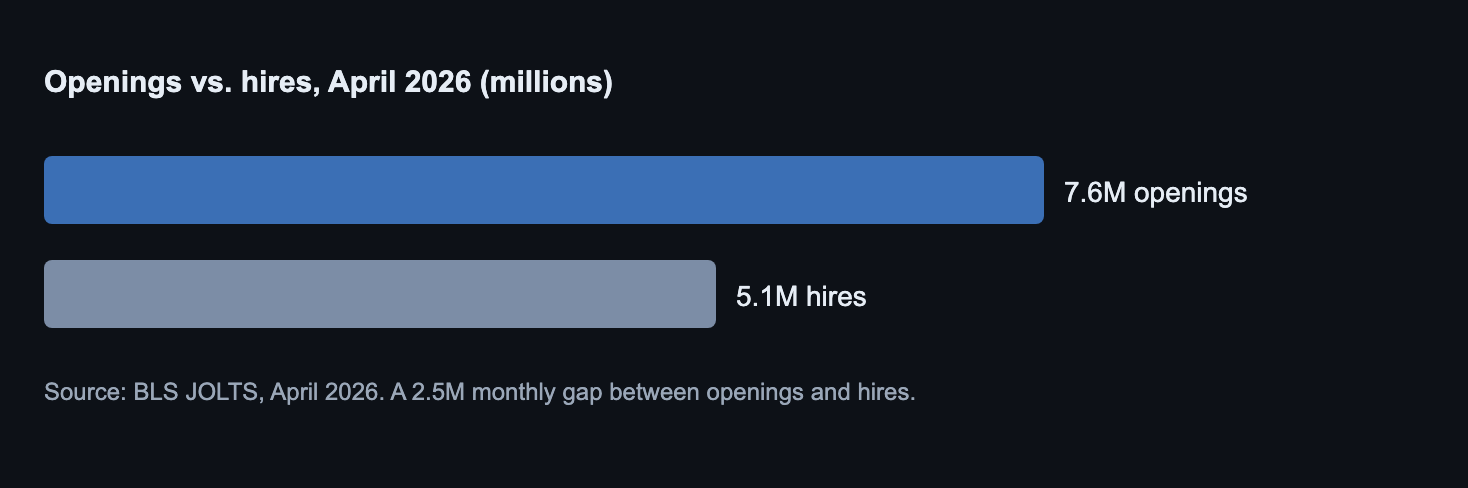
It shows up in the aggregate. In April 2026, U.S. employers had 7.6 million open jobs but made just 5.1 million hires, a gap of roughly 2.5 million openings a month that aren't turning into anyone getting hired.
Both sides are exhausted. Both sides think the other is acting in bad faith. Neither is. They're both rational actors in a system that punishes everyone.
Why every current "fix" makes it worse
Most of the industry, including the auto-apply tools, ours included, has been optimizing the wrong variable. We made it easier to apply. We did not make it easier to get hired. Those are not the same thing, and conflating them is the original sin of this category.
If every engineer has a cannon, nobody's louder. You just get a war zone. Helping a candidate send 500 applications instead of 50 doesn't help the candidate. It raises the noise floor for everyone, including them, and forces companies to filter even harder. More volume is not the answer to a problem caused by volume.
The same is true on the employer side. Better, faster AI screening doesn't fix hiring. It just lets companies reject the flood more efficiently, which encourages more flood. You can't out-automate a problem that automation created.
There's a quieter lesson underneath all of it. In a controlled study, experienced developers using AI tools on their own large codebases felt about 20% faster but were measured 19% slower. "I use AI" isn't a skill. The scarce, expensive thing is judgment: taste, architecture sense, knowing when the confident answer is wrong. That's what hiring has to start measuring, and what candidates have to start proving.
Our thesis: the next era of hiring runs on signal, not volume
The proxies the old system ran on, keywords, application volume, who-you-know, are dying. They're trivially gameable now, so they've stopped carrying information. When a signal becomes free to fake, it stops being a signal.
What replaces them is verifiable signal: provable evidence of what someone can actually do, routed to the few people who actually decide. Not a keyword-matched résumé. Not 500 applications. Proof, and precision about where that proof goes.
Concretely, the winning model does three things the current one can't:
-
Reward fit over volume. The goal isn't to help a candidate apply to more jobs. It's to help them apply to the right ones, well, and look hand-picked because they are. Fewer, better, genuinely-matched shots. The candidate gets their time and dignity back; the company gets a smaller, higher-signal pile.
-
Restore signal for both sides. Companies need to see who can really do the work without reading a thousand near-identical résumés. Candidates need to prove it without playing keyword roulette. The same layer serves both, because in a two-sided market you cannot fix one side alone. Every prior attempt failed precisely because it tried.
-
Make the human moment count again. Automation should clear the noise so a human conversation can happen, not replace the human conversation with a second layer of automation. The day a hiring product measures its success in "applications sent" instead of "interviews landed," it has become the problem.
That's the bar we hold ourselves to. If ApplyIn ever optimizes for volume over outcomes, we've joined the arms race we exist to end. Hold us to it.
There's a tell for where this goes next: regulated industries are leading. In fintech, "it mostly works" is a fireable phrase, so hiring there already over-indexes on demonstrated judgment. That's a proof-of-work bar, not a keyword bar, and it's why fintech engineering is quietly one of the healthier corners of the market right now. The rest of hiring is moving the same direction, just slower.
Why we're optimistic (yes, optimistic)
Everyone calls this the worst US job market in a decade. We're building in it on purpose, because broken systems don't get replaced when they're working "fine." They get replaced when they're so obviously broken that both sides admit it.
We're there. Engineers know applying is a black hole. Companies know they're drowning in résumés they can't read. Nobody is defending the status quo. That consensus is exactly the condition under which the old way finally gives.
The next five years of how people find work will look nothing like the last five. The keyword era is ending. The volume era is ending. Something built on real signal is going to take their place.
We'd rather build that than mourn the old one. If you're an engineer in the trenches right now, hear this clearly: it's not you, the system is genuinely broken, and we're working on our corner of it.
For the numbers behind the split, and which side you're standing on, read the 2026 dev job market in detail. And if you're tired of pouring hours into the volume game, that's exactly the problem ApplyIn exists to solve, matching your background against real openings so you apply with leverage instead of volume.
Sources: U.S. job openings and hires, BLS JOLTS (April 2026). LinkedIn application volume, eWeek citing New York Times reporting (2025). New-grad share of Big Tech hires, SignalFire State of Tech Talent. Ghost-job prevalence, Clarify Capital (2026). AI coding productivity, METR randomized controlled trial (2025). Figures move month to month; verify current numbers before relying on them.