Career Advice
AI Skill Atrophy: The Skill the Market Pays More For
Adam Ross ·
The cleanest evidence that using AI erodes the skill underneath it didn't come from software. It came from gastroenterology.
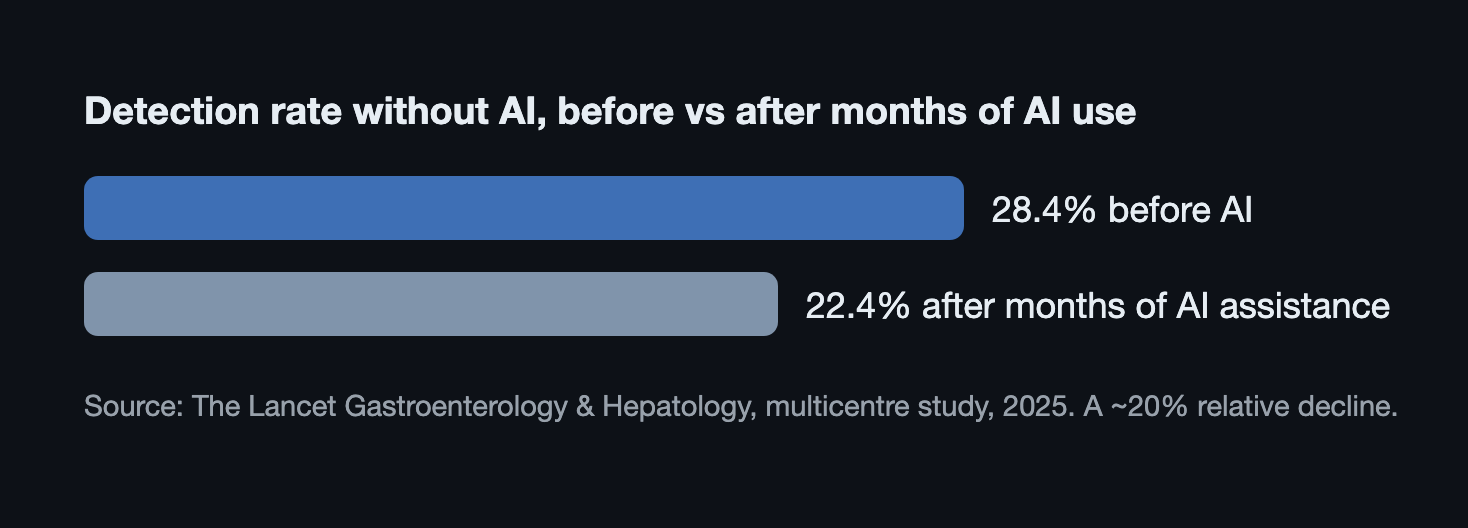
Through 2025, four endoscopy centres in Poland gave their doctors AI assistance for colonoscopies. The AI flags polyps; detection rates go up; everyone's happy. Then researchers checked what happened on the days the doctors worked without the AI. Before the rollout, they caught adenomas in 28.4 percent of unassisted procedures. After a few months of routine AI use: 22.4 percent. About a fifth of the unassisted skill, gone in months, in experienced specialists, published in The Lancet's gastroenterology journal under the polite heading of "deskilling risk."
Nobody has run this study on software engineers, the profession that adopted AI harder and faster than any other. That gap in the evidence should bother you more than the finding itself.
But we don't have nothing. We have proxy measurements from every direction, and they all point the same way. They also show something the doctors' study can't: at the exact moment the skill is atrophying, the hiring market has started paying a premium for it.
The muscle that shrinks first is judgment
Not syntax. Not output. Nobody should mourn the hours we used to spend hand-writing boilerplate. What atrophies is the layer above the code: why this approach and not the other one, why this is wrong even though it runs, whether this should be built at all.
That's what practitioners started reporting first. Namanyay Goel's essay "New Junior Developers Can't Actually Code," which tore through Hacker News in early 2025, put it in one line: "Sure, the code works, but ask why it works that way instead of another way? Crickets." His diagnosis wasn't that AI makes people lazy. It's that the understanding you used to build by doing the work stops being built when the work is done for you.
The research backs the anecdotes. A Microsoft Research and Carnegie Mellon study of 319 knowledge workers, published at CHI 2025, found a consistent pattern: the more confidence people had in the AI, the less critical thinking they applied to the task. The thinking doesn't stop, exactly. It gets offloaded, and offloaded muscles are the ones that shrink.
You can watch it in the world's codebases. GitClear analyzed 211 million changed lines of code from 2020 through 2024 and found that in 2024, for the first time, copy-pasted lines exceeded refactored ones, and the share of changes that involve actually restructuring code fell from about 25 percent to under 10. More code, more duplication, less of the activity that requires understanding what's already there.
You won't feel it happening. That's the trap.
METR ran a randomized controlled trial with 16 experienced open-source developers working real tasks in their own mature repos with early-2025 AI tools. With AI, they were 19 percent slower. Afterward, they estimated the AI had made them about 20 percent faster.
It's a small study, and METR itself flags that 2026 tools may land differently. But the direction of the error is the part that matters, because the instrument you'd use to detect your own decline, how it feels, reads backwards. AI assistance feels like acceleration more or less unconditionally. The doctors in the Lancet study didn't feel their detection rate drop either. Atrophy never announces itself. It just waits for the day the assistance isn't there: the outage, the whiteboard, the system-design round, the production incident the model has never seen.
Meanwhile, the market repriced exactly this skill
While the judgment muscle shrinks across the profession, the labor market has started bidding its price up.
PwC's 2026 AI Jobs Barometer, built on over a billion job ads, describes hiring splitting into a two-track market: as AI commoditizes raw output, the jobs pulling ahead are the ones rewarding judgment, creativity, and leadership. They're growing about twice as fast as jobs where AI can do most of the task, with 42 percent higher wage growth. The starkest number in the report: in AI-exposed occupations, even entry-level roles are now seven times more likely to demand traditionally senior-level skills like judgment. The bottom rung didn't just get harder to reach. It got redefined as a judgment job.
You can see the same repricing in the posting data. Indeed's Hiring Lab found US software-developer postings up about 15 percent since early 2025 while overall postings fell, and 71 percent of the past year's increase came from senior roles. The share of tech postings demanding five-plus years of experience climbed from 37 to 42 percent. Companies aren't paying for hands on keyboards. The models type now. They're paying for the person who can tell when the model is wrong.
Which is, precisely, the skill in question. Stack Overflow's 2025 survey found the single most-cited frustration with AI tools, named by 66 percent of developers, is output that's "almost right, but not quite." Catching almost-right is judgment. It's also why AI leverage concentrates with the people who kept the muscle: in Fastly's survey of nearly 800 developers, seniors were about 2.5 times more likely than juniors to ship substantial amounts of AI-generated code, not because they trust it more, but because they can verify it.
So the loop closes into something uncomfortably clean. Lean on the model naively and you're training yourself out of the one skill the market is repricing upward, while competing on the one thing the model already does for free.
I sell an AI tool. This applies to me and to you.
ApplyIn is an AI product, and I use AI to build it, so no, the lesson is not "go artisanal." The tools are real leverage and unilaterally refusing them mostly means someone with your skills and better tooling outships you.
The lesson is about which half of the work you hand over. The same distinction applies to the job search itself, which is where I watch this play out daily. Hand AI your searching, your tailoring, your application grunt work: the volume layer that was never a good use of a human evening. You get your time back. Hand it your thinking instead: what you actually want, what you're actually good at, what you'd actually say in an interview about the work on your résumé. Now you're showing up to a judgment-priced market having outsourced your judgment. Interviewers in 2026 probe exactly the question Goel flagged: why this way and not the other way? Crickets is not a salary band.
Keeping the muscle while keeping the tools
Not a productivity framework. Just the habits that map directly onto the atrophy evidence:
- Predict before you generate. Before accepting AI output, write one sentence: what you expect and why. You're forcing the critical-thinking pass the CHI study shows confidence erodes. When the output surprises you, that gap is the curriculum.
- Review AI code like a junior's PR. Not "does it run" but "why this way." If you can't answer, you're the one merging code you don't understand: the exact pattern from Goel's essay, at senior speed.
- Keep hard reps for yourself. The doctors' detection rate fell because the AI did the detecting. Pick the parts of your system where you stay the detector (the core design, the gnarly debugging, the architecture call) and do those unassisted on purpose.
- Practice explaining trade-offs out loud. The interview rounds that decide offers now are the ones a model can't sit: why you chose this, what breaks it, what you'd do with half the time. That's a rep you can do weekly for free.
The systemic part, because there always is one: if you've felt yourself getting vaguer about your own codebase this year, that isn't a personal failing. It's the default trajectory of tools that are genuinely good, wielded the way the marketing suggests. The whole pipeline has this shape now: AI applying, AI screening, judgment draining out of both sides. The people who come out ahead aren't the ones who use AI most or least. They're the ones who kept custody of their own thinking while the market repriced it. That's been the thesis behind everything we write here: in a market drowning in generated output, proof of judgment is the scarcest signal left.
The doctors got their study. Yours is running on you right now, uncontrolled. You get to pick which arm of it you're in.
Sources: Endoscopist deskilling (unassisted adenoma detection 28.4% → 22.4% after routine AI exposure), Budzyń et al., The Lancet Gastroenterology & Hepatology, multicentre observational study (2025). Practitioner account, Namanyay Goel, "New Junior Developers Can't Actually Code" (2025). Critical-thinking offloading (n=319 knowledge workers), Lee et al., Microsoft Research / Carnegie Mellon, CHI 2025. Developer slowdown RCT (19% slower, perceived 20% faster; n=16, early-2025 tools), METR (2025). Code copy-paste exceeding refactoring (211M changed lines, 2020–2024), GitClear (2025). Two-track labor market, 42% wage-growth gap, 7x entry-level judgment requirement, PwC Global AI Jobs Barometer (2026). Senior-role share of posting growth (71%) and experience tightening (37% → 42%), Indeed Hiring Lab (2025–2026). "Almost right, but not quite" frustration (66%), Stack Overflow Developer Survey (2025). Senior vs junior AI-code shipping (~2.5x, n=791), Fastly (2025). Figures move; verify current numbers before relying on them.