Career Advice
The AI Doom Loop: AI Applies, AI Screens, Humans Opt Out
Adam Ross · Thu Jul 09 2026
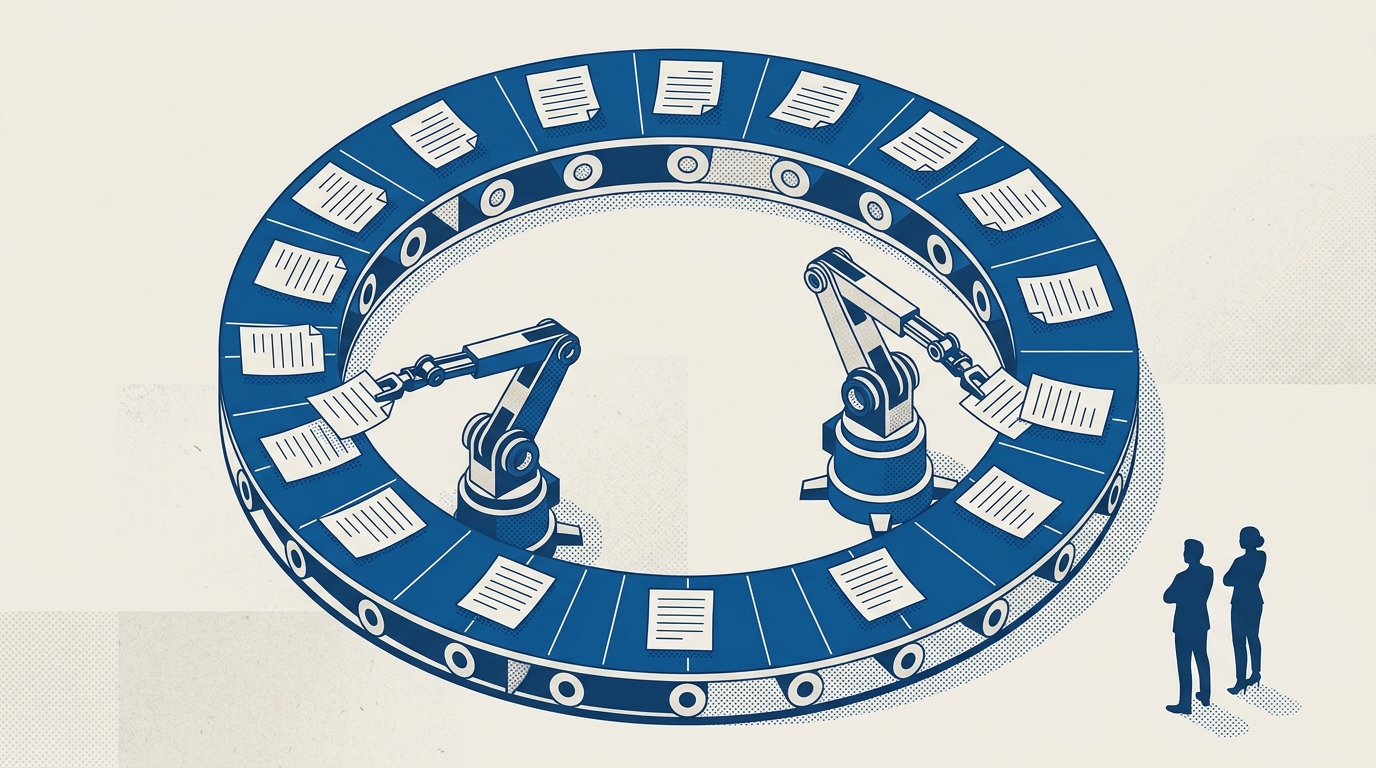
An AI helps you write the application. Another AI decides whether it gets read. On a growing share of applications, no human ever touches the thing being decided.
That's not a dystopian forecast. It's a plain description of the 2026 US hiring pipeline. And it's worth walking through the mechanics, because they explain two things at once: why your job search feels like shouting into a void, and why the two most popular fixes, "use more AI" and "ban AI from hiring," are both the wrong exit.
Nobody designed this loop. It assembled itself.
Every step was locally rational.
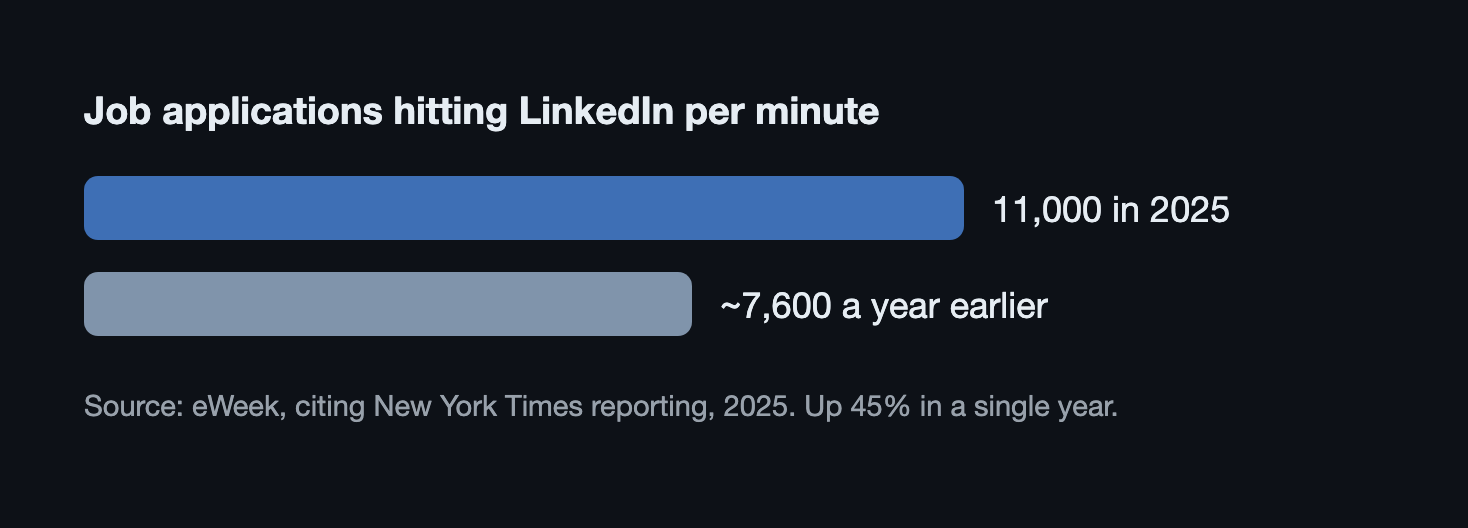
Candidates moved first. When applying is miserable and reply rates are near zero, a tool that writes and fires applications at scale is irresistible. So volume exploded: LinkedIn alone now absorbs around 11,000 job applications a minute, up 45% in a single year.
Employers responded the only way the arithmetic allowed. A req that draws 800 applications in 48 hours will not be read by a person who has any other job duties, so screening got automated too: résumé parsers, keyword scores, ranking models, auto-rejects. Most applications are now dispositioned before a human is involved at all.
And that closes the loop. The more applications AI sends, the more aggressively AI has to filter. The more aggressively AI filters, the more applications people feel they need to send to get through. Volume goes up, signal goes down, and every cycle tightens the next one. Two models end up negotiating your career, and the humans on both ends feel weirdly powerless, because they mostly are.
The "humans opt out" part is already happening
Talk to recruiters and you hear the same thing: hundreds of plausible-looking applicants per opening and no confidence that any given profile reflects a real person's real abilities. So they stop reading and start trusting the score. That's not laziness. It's the only move the flood leaves them.
Candidates are opting out of belief too, and they have receipts. Applications disappear without acknowledgment. A meaningful slice of postings, plausibly around one in five, may be ghost jobs that were never going to hire anyone. And when the interview itself became an AI, people started walking mid-interview: roughly 4 in 10 candidates report abandoning an AI-led interview partway through.
This is the quiet catastrophe inside the noisy one. Hiring is, at bottom, a trust protocol: both sides show up because they believe the channel carries real information. Traffic is at record highs, and belief is gone. A channel nobody believes in is dead, no matter how much data moves through it.
The uncomfortable part: I'm building one of the machines
ApplyIn is an AI application tool. I'm not going to pretend otherwise, and I'm not going to pretend the category I work in didn't help fill the pipe.
But the lesson I take from the loop is not "less AI." You can't un-invent the cannon, and unilateral disarmament just means the other side's models decide your career without your input. The lesson is that mass-apply was never the product. Signal is. The fix is proof of what you can actually do, matched to roles where it genuinely fits, put in front of the few people who actually decide, at a pace a human could have sustained. An application that's more likely to be real, not just more numerous, is the only thing that makes the loop worth exiting for both sides.
That's the bet, anyway. The market will grade it.
Getting out of the loop while it still exists
If you're an engineer in the flood right now, you can't wait for the system to fix itself. A few moves that follow directly from the mechanics:
- Measure your search in humans reached, not applications sent. Four hundred unread applications round to zero. One conversation with someone who owns the req does not. Referrals and warm intros aren't nice-to-haves anymore; they're the main road around the loop.
- Make proof, not claims. The screening AI can't verify "team player." A shipped project with a write-up of the decisions you made, the trade-offs you weighed, and what broke is evidence of judgment, which is the one thing the flood can't counterfeit.
- Aim where the flood is thinnest. The loop is worst at brand-name companies with fully automated funnels. Regulated, less glamorous corners of the market still read, still interview like humans, and are still hiring; fintech is the standing example.
- Use AI to sharpen, not to multiply. Point it at understanding a company, tailoring genuine evidence, and finding the right openings, not at buying more lottery tickets in a lottery everyone else has also automated.
The loop won't un-invent itself, and neither side can quit it alone. What ends it is signal that both sides can believe again. That's the standard I think every tool in this category should be held to, including mine. If you want the full argument for how hiring got here and where it goes next, it's in our thesis on why hiring broke.
And if you're the human in the loop tonight, firing applications into the void and hearing nothing back: the silence is the system talking to itself. It isn't a verdict on you.
Sources: LinkedIn application volume (≈11,000 submissions per minute, up 45% year over year), eWeek citing New York Times reporting (2025). Ghost-job prevalence (~1 in 5 postings), Wall Street Journal reporting (2025) and Clarify Capital (2026). AI-led interview abandonment (~4 in 10 candidates), Fortune citing Greenhouse data (2026). Figures move month to month; verify current numbers before relying on them.