Career Advice
Why Fintech Is the Quiet Hot Engineering Market
Adam Ross · Wed Jul 01 2026

Fintech is quietly one of the best engineering job markets in the US right now, and almost nobody is talking about it.
While the consumer-tech logos everyone wants to work for keep announcing cuts, banks and fintechs are doing the opposite. They're in an arms race for engineers who can ship AI into systems where a wrong answer costs real money or a regulator's trust. The work is less glamorous, harder to fake, and considerably better paid than the crowded scramble for the same fifty brand-name jobs.
I'll use this space to break down where the fintech engineering market is actually moving. The short version of today's argument: follow the regulation, not the hype.
The signal is in the job descriptions
Here's the clearest tell that something is shifting. AI skills now show up in about 42% of US software job descriptions, up from roughly 8% three years ago. That's more than a 5x jump in four years. And the curve is steepest in finance, where the demand isn't for someone who can prompt a chatbot, it's for someone who can build models that won't get the company sued.
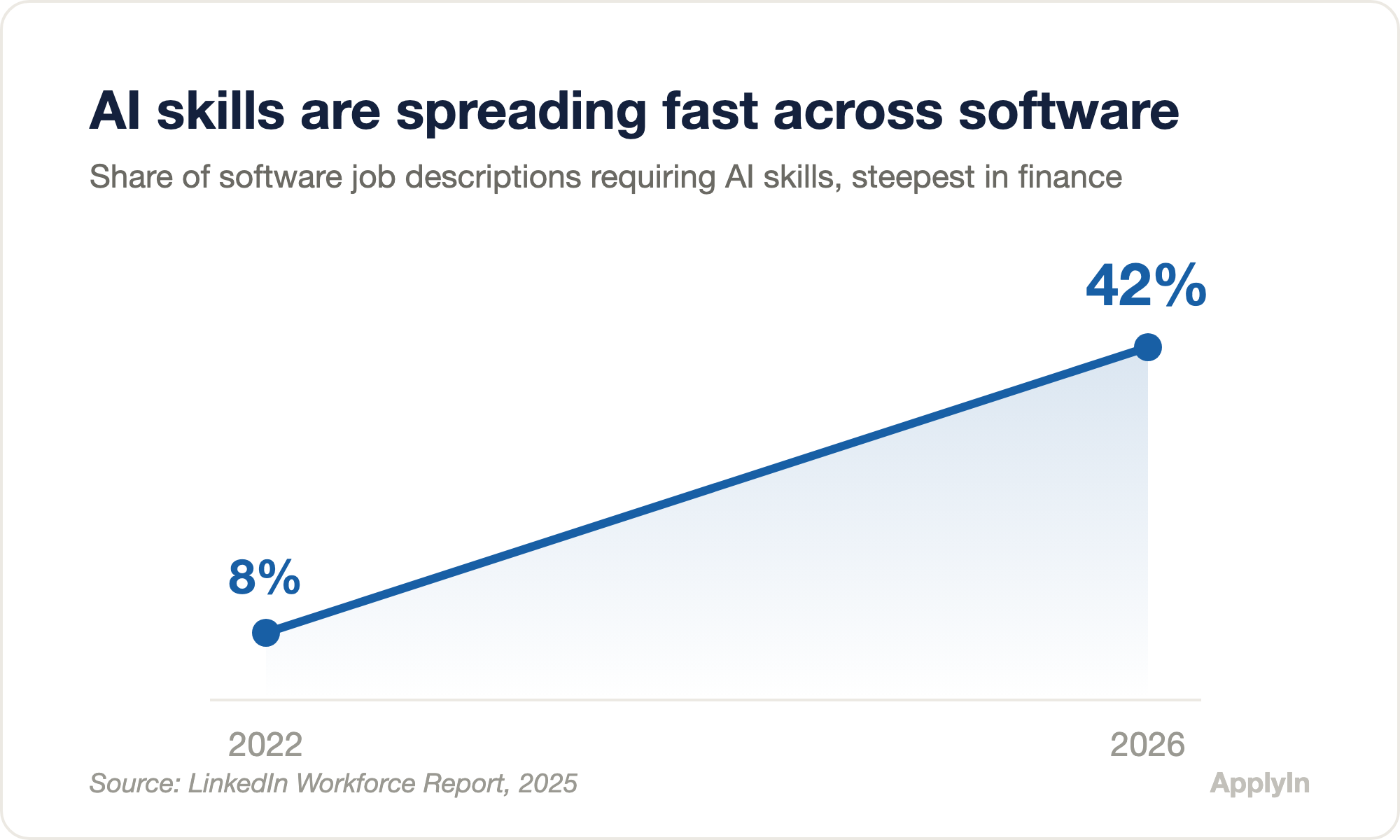
That gap matters because it tells you where the durable, well-paid work is concentrating. Consumer tech can afford to experiment with AI in a feature flag and roll it back when it misbehaves. A bank can't. When you put a model anywhere near payments, lending, fraud, or compliance, "it mostly works" stops being acceptable and starts being a fireable phrase. So the bar for the engineer goes up, and so does the price the company will pay to clear it.
Why "boring" finance is hiring while exciting tech is cutting
The instinct most engineers have is to chase the companies with the best brand, the splashiest product, the most exciting demo. In 2026 that instinct is pointed at exactly the part of the market that's contracting.
Finance is moving the other way for three structural reasons, and none of them are hype:
-
Regulation is a moat, not a nuisance. The same compliance burden that makes fintech feel slow is what makes its engineering work hard to automate away and expensive to get wrong. You can't replace the person who owns whether a payment system is correct and auditable with a subscription. That's job security disguised as red tape.
-
The money is already there. Banks and fintechs don't need a venture round to justify a hire. They have revenue, regulatory deadlines, and fraud losses that an engineer directly reduces. When budgets tighten across tech, "this person stops us losing money" is the role that survives the cut.
-
The work AI created is concentrated here. Putting AI into a regulated system is one of the genuinely hard, genuinely new engineering problems of this decade, model risk, explainability, audit trails, failure modes that have legal consequences. That's net-new demand, and finance has more of it than anywhere else.
Put those together and you get the quiet boom: a part of the market that's expanding its engineering headcount precisely because the work is hard, consequential, and tied to money that already exists.
What this means if you're an engineer
If you've spent this year firing applications at the same fifty consumer-tech logos as everyone else and hearing nothing back, you may not have a skills problem. You may be fishing in the most crowded pond on purpose.
The fintech reframe is this: the slightly less exciting role at a payments company, a lending platform, or a bank's modernization team is often the one with the better odds, the better pay, and the more defensible career arc. The work that sounds boring on the surface, correctness, auditability, idempotency, what happens when a transaction half-fails at 2am, is exactly the judgment that's becoming scarce everywhere else too. Finance just demands it first.
This connects to the larger split running through the whole market. The openings didn't disappear in 2026, they moved up the stack toward senior judgment and toward AI-adjacent work, while the bottom of the ladder thinned out. Fintech is where that shift is most visible and most rewarded. For the full shape of that divide, read the 2026 dev job market in detail, and for why the whole hiring system bent this way, our thesis on what broke and what replaces it.
You don't need a finance degree to make this move. You need to show you think about failure, money, and rules, not just throughput. Demonstrate that you can own whether something is correct in production, and the regulated corners of tech will pay you more than the crowded ones, with less competition for the seat.
The hype is loud and crowded. The regulation is quiet and hiring. Aim accordingly.
If you do decide to point your search at fintech, the goal isn't to apply to more of those roles, it's to apply to the right ones with real leverage, which is exactly the problem ApplyIn exists to solve: matching your background against the openings that actually fit, so you show up hand-picked instead of buried in the pile.
Sources: AI skills share of software job descriptions, LinkedIn Workforce Report (2025). "It mostly works" as a fireable standard and the regulated-systems moat, ApplyIn analysis of the 2026 fintech hiring market. Market-split figures detailed in the linked posts. Figures move month to month; verify current numbers before relying on them.