Job Search
Stripe Software Engineer Interview Guide (2026)
Adam Ross ·

Stripe's interview loop has a reputation that precedes it: the company that processes 1.6% of global GDP doesn't ask you to invert a binary tree. You code in your own editor, in your own language, on problems that look suspiciously like actual work, including one round where they hand you an unfamiliar codebase with a real bug in it.
That's great news if you're a working engineer, and a trap if you prep for it like a FAANG loop. The skills that get you through a LeetCode gauntlet are not the skills this loop grades.
This guide covers the full process as of 2026: every round, verified pay bands, what Stripe actually screens for, and the engineering roles open right now. One honesty note up front, because most guides skip it: Stripe doesn't publish its interview process. What follows is the consistent consensus of candidate reports and interviewing.io's Stripe guide, which agree on the shape; where something is thinner than that, we say so.
Why is Stripe such a target for engineers in 2026?
Because it pairs big-tech scale and pay with a product engineers actually respect.
The numbers from Stripe's 2025 annual letter, published February 2026: businesses on Stripe processed $1.9 trillion in total volume in 2025, up 34% year over year, and the company remained, in its own words, "robustly profitable." The same month, a tender offer valued Stripe at $159 billion, up 74% from the $91.5 billion round a year earlier. Headcount sits somewhere around 8,000 to 9,000 by third-party estimates, small relative to the surface area of the product.
Engineering-wise, it's the company whose API docs the rest of the industry copies, with hubs in San Francisco, Seattle, Dublin, and Singapore, plus a formal Remote hub it's operated since 2019. If you're weighing the sector broadly, our fintech engineering guide covers where Stripe sits in the landscape; this post is about getting through its door specifically.
What does Stripe's interview loop look like?
Five stages, typically four to six weeks end to end, though candidate reports say it can compress to two if you push.
→ Recruiter call, ~30 minutes. Background, motivation, logistics.
→ Technical phone screen, ~1 hour. A practical coding problem, not a puzzle. You choose the environment: your own IDE with screen share, or CoderPad.
→ Prep call. A second recruiter call that exists purely to walk you through the onsite. Use it; the recruiters will tell you exactly which rounds you're getting.
→ Onsite, ~5 hours. For most levels: Coding, Bug Squash, Integrations, System Design, and a Behavioral round with a hiring manager (Stripe calls one variant the "Leveler" interview, which helps set your level). At Staff and above, the Integrations round is replaced by a Presentation round on your past work. Every round is about an hour.
→ Offer and leveling. Level is set by the loop, not the job posting, which is why the Leveler round matters more than most candidates realize.
Two structural notes. First, the own-editor, own-language rule holds across the coding rounds, so there's zero reason to grind in a language you don't actually work in. Second, the loop is unusually consistent across teams; you're interviewing for a level at Stripe more than for a specific req.
What makes the Bug Squash and Integrations rounds different?
They're work samples wearing an interview costume, and they're where FAANG-style prep goes to die.
Bug Squash drops you into a realistic codebase you've never seen, with a real-world bug to find and fix. Some reports describe a popular open-source repo in your chosen language; others describe a scaffolded codebase modeled on an actual historical Stripe bug. Either way, the graded skill is the same: orient fast in unfamiliar code, reproduce the failure, narrate your debugging out loud, fix it without breaking the tests. It is the round candidates on Blind most consistently report bombing, precisely because nothing in a LeetCode regimen exercises it.
Integrations gives you an API or spec and asks you to build something against it: parse the docs, handle the request/response shapes, deal with the edge cases the spec buries. For a company whose product is an API, this is about as honest as job-sample testing gets.
On AI tools: candidates consistently report that AI assistants are not allowed in Stripe interviews, which puts Stripe on the restrictive end of a market where some companies now pilot AI-permitted rounds. That's an anecdotal consensus rather than published policy, so confirm with your recruiter rather than assuming either way.
What does Stripe pay software engineers?
Levels run L1 through L6. Verified US medians from levels.fyi, current as of August 2026:
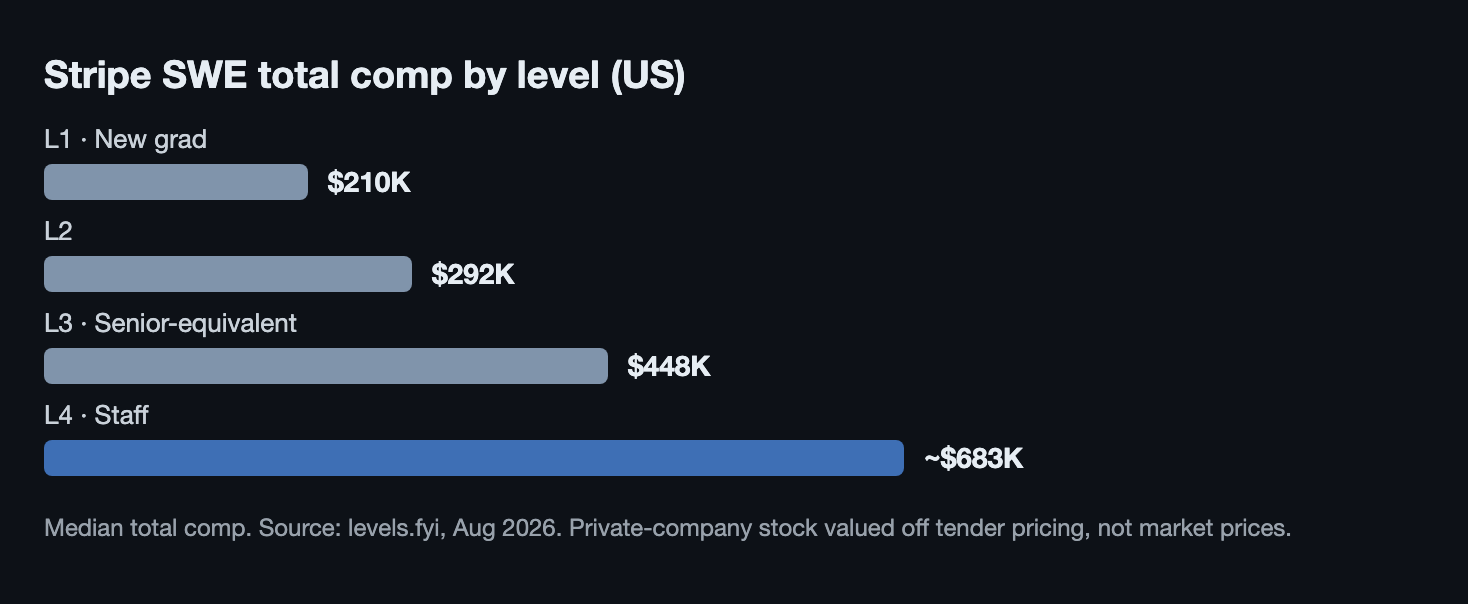
Splits at L3, for shape: roughly $228K base, $189K stock, $31K bonus. L4 is the noisiest band; levels.fyi shows everything from $543K to over $1M depending on the cut, so treat $683K as a midpoint, not a promise.
The stock deserves one caveat and one genuine plus. The caveat: Stripe is private, so those equity numbers are imputed from tender and 409A pricing rather than a ticker. The plus: Stripe has made liquidity a habit, running recurring tender offers that let employees actually sell, at $65 billion in 2024, $91.5 billion in February 2025, and $159 billion in February 2026. Private-company paper with a track record of becoming money is a different asset than the usual startup lottery ticket.
What is Stripe actually screening for?
Stripe publishes six operating principles, and two of them show up in the loop constantly: "Users first" and "Create with craft and beauty." The culture page's line is that "well-crafted work indicates care for the user," and the interviews are built to catch whether you work that way when nobody makes you: whether your Bug Squash fix includes the test, whether your Integrations code handles the error path the spec only implies, whether your system design starts from what the user of the API experiences when a webhook retries.
The behavioral rounds probe the same principles from the story side: disagreements you handled with evidence ("collaborate egolessly" is another of the six), work you're proud of at the level of detail only the person who did it would know. Prep those stories properly; our behavioral interview guide for engineers is effectively the companion piece to this section, and the "sound like you were there" bar is higher at Stripe than most places.
Which Stripe engineering roles are open right now?
As of August 18, 2026, Stripe's board lists 573 open roles, over 100 of them with "engineer" in the title. A representative cut, with direct application links:
| Role | Focus | Location |
|---|---|---|
| Software Engineer | Generalist | Chicago |
| Software Engineer | Generalist | Seattle |
| Software Engineer | Generalist | South San Francisco |
| Senior Software Engineer | Generalist, senior | South San Francisco |
| Backend Engineer, Core Technology | Core platform | US-Remote, Chicago, Seattle, SF |
| Backend Engineer, Link (US) | Consumer payments | NYC, Seattle, SF, Toronto |
| Software Engineer, Infrastructure | Infra | Seattle |
| Machine Learning Engineer | ML | South San Francisco |
| Machine Learning Engineer, Radar | Fraud ML | Seattle |
| Software Engineer, Bridge | Stablecoins | SF, NYC, Seattle |
| Software Engineer, Vulnerability Management | Security | US-Remote |
| Staff Software Engineer, API Platform | API platform, staff | SF, Seattle |
Beyond the US: active postings in Dublin, London, Toronto, Singapore, Bucharest, and São Paulo, plus intern roles in Bengaluru and Dublin. The full board is here.
Context worth knowing: Stripe cut 300 people (about 3.5%) in January 2025 and kept hiring through it, which is the pattern across fintech right now, trimming and recruiting at the same time. These listings churn, and fresh postings are where your odds actually live, which is exactly why ApplyIn watches for new roles matching your stack and applies the day they open rather than the week you next check the board.
How should you prep differently for Stripe?
The loop is a work sample, so the prep is reps of real work:
→ Drill unfamiliar codebases, not puzzle sets. Clone a mid-sized open-source repo in your language, pick a closed bug report from its tracker, and race yourself to reproduce and fix it without reading the actual patch. Three or four of these is better Bug Squash prep than a month of algorithms.
→ Build one API integration under time pressure. Take any public API with decent docs and build a small working client in under an hour: auth, pagination, error handling, retries. The Integrations round is this exact motion.
→ Practice narrating while you debug. The rounds grade your process out loud. If you've never talked through a stack trace in real time, it's a skill, and it's trainable in a week.
→ Flavor your system design with payments reality. Idempotency keys, exactly-once versus at-least-once, ledgers, webhook retries, PCI boundaries. You don't need domain expertise, but reaching for these concepts unprompted reads exactly like "users first."
→ Build your story bank before the recruiter call, not the night before the onsite. Six stories, indexed by principle, per the behavioral guide.
And make sure the resume that starts all this survives parsing; the ATS-proof resume guide applies double at a company whose pipeline runs on Greenhouse.
FAQ
How long does Stripe's interview process take?
About four to six weeks from recruiter call to offer in the common case, per candidate reports, and as little as two if you have competing offers and say so. The prep call before the onsite is the natural place to ask about timeline, and Stripe recruiters are reported to be straight about it.
Is Stripe remote-friendly for engineers?
More than most at its scale. Remote has been a formal engineering hub since 2019, and current postings include US-Remote roles across core platform and security. Plenty of roles are hub-anchored, though, so check the specific listing rather than assuming.
Does Stripe ask LeetCode-style questions?
Not in the classic sense. The coding rounds are practical: build, debug, and extend realistic code, in your editor, in your language. You still need sharp fundamentals, comfortable data-structure fluency, and clean code under time pressure; you just won't be regurgitating dynamic-programming templates. Prep accordingly, because the candidates who fail this loop are usually over-prepared for the wrong exam.
Can I use AI coding tools in the interview?
Candidate reports through 2026 consistently say no, Stripe prohibits AI assistance in interviews, even as parts of the market move the other way. Treat that as the default and confirm with your recruiter. Prepping with AI beforehand is a different matter entirely, and drilling AI-generated bugs in practice repos is genuinely effective Bug Squash training.
The honest summary: Stripe's loop is the rare one where the best prep is being good at the actual job, plus targeted reps on two unusual round formats. That's a better deal than the algorithm lottery, but only if you respect the difference. Prep the Bug Squash, build one integration, index your stories, and apply while the posting is fresh. The loop rewards engineers who ship; show up as one.