Career Advice
How to Get a Software Engineering Job in Fintech (2026 Guide)
Adam Ross ·

If you've spent 2026 firing applications at the same fifty consumer-tech logos as everyone else, you already know how that's going. Triple-digit applicant counts, reposted listings, silence.
Meanwhile the part of the market that's actually expanding its engineering headcount is the part most engineers still skip on instinct: finance. Payments companies, B2B spend platforms, brokerages, and the modernization teams inside banks are competing hard for engineers, and the pool of people who bother to point their search there is a fraction of the crowd chasing consumer tech.
We've made the argument for fintech as a market before. This guide is the practical version: what fintech teams screen for, which companies to target, what the interview loop looks like, and how to get in without a day of finance experience. It's also the hub for the per-company interview guides we're publishing through the fall, starting with Stripe.
Why should engineers target fintech in 2026?
Because it's where demand held up. TrueUp's open-jobs data counted roughly 67,000 open US software engineering roles in Q1 2026, the most since 2023. That demand isn't spread evenly: it concentrates in senior and AI-fluent roles, and finance is the vertical bidding hardest for exactly that profile. In the same data, US AI/ML engineer postings are up about 85% year over year.
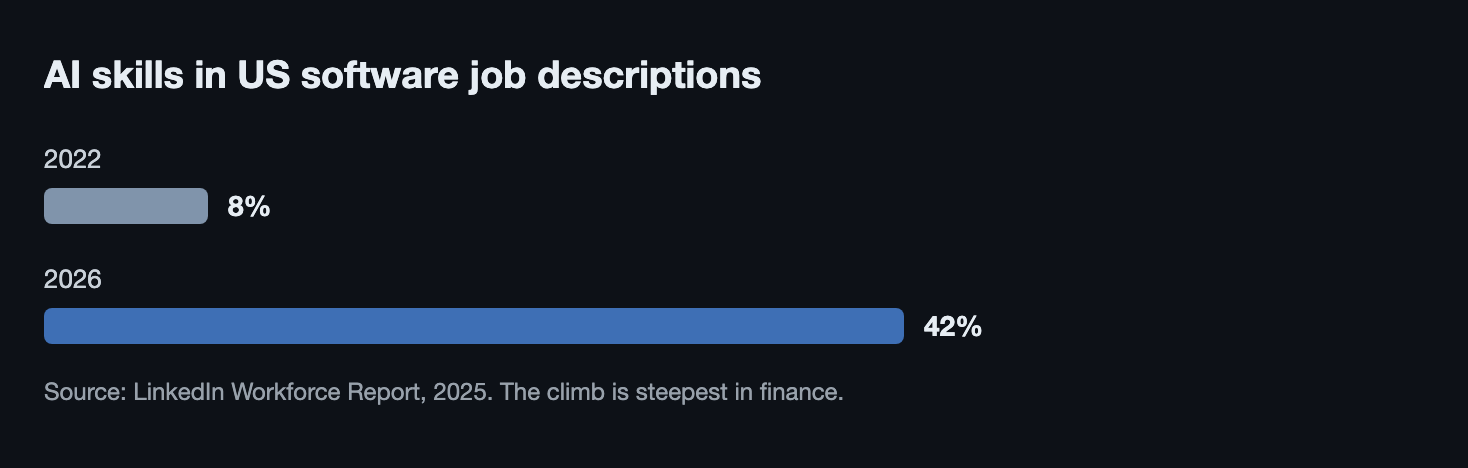
The clearest tell is in the job descriptions themselves. AI skills now appear in about 42% of US software JDs, up from roughly 8% in 2022, and the climb is steepest in finance.
The structural reason is simple: putting AI anywhere near payments, lending, fraud, or compliance is one of the genuinely hard, genuinely new engineering problems of this decade. A consumer app can ship a model behind a feature flag and roll it back when it misbehaves. A bank can't. That raises the bar for the engineer, and the price the company will pay to clear it.
Two more things work in your favor. Finance funds engineering out of revenue and regulatory deadlines, not venture rounds, so the roles survive budget cuts. And the compliance burden that makes fintech feel slow is the same thing that makes its engineering work expensive to get wrong and hard to automate away.
Do you need a finance background to get hired?
No. What fintech teams actually screen for is a way of thinking: engineers who reason about failure, money, and rules, not just throughput.
You probably have more transferable evidence than you think. Any of these count:
→ Billing, checkout, subscriptions, or usage metering. That's money movement with real correctness stakes.
→ Anything involving idempotency, retries, or exactly-once processing. "What happens when this request fires twice" is the fintech interview question.
→ Fraud, abuse, or risk work of any kind, even spam filtering.
→ Systems with audit or compliance requirements: access logs, data retention, SOC 2 controls.
If you have none of the above, a focused side project closes the gap faster than a course certificate. A small double-entry ledger with idempotent writes and a reconciliation job, built and written up honestly, demonstrates the exact judgment these loops probe for.
What skills do fintech teams actually screen for?
The stack is deliberately unexotic: Java, Kotlin, Go, or Python; Postgres or another relational database taken seriously; a message queue; AWS or GCP. Fintech mostly doesn't hire for framework novelty. It hires for what you do with boring tools when the answer has to be right.
The differentiator is domain vocabulary. None of it is hard, and most engineers never bother to learn it:
→ Money as data. Why amounts are integers in minor units, never floats. Currency handling. Rounding rules.
→ Double-entry ledgers. Debits, credits, and why every serious money system is append-only.
→ Idempotency. Idempotency keys, safe retries, deduplication. The single most-tested concept in fintech system design.
→ Reconciliation and settlement. What happens when your ledger and the bank's file disagree, and whose job it is to notice.
→ The rails. ACH, wires, RTP, card networks, and roughly how long each takes and how each fails.
→ The compliance layer. KYC, AML, PCI DSS, SOC 2. You don't need depth, you need to not look surprised.
→ AI in regulated systems. Model risk, explainability, audit trails, human-in-the-loop review. This is where the new demand is concentrated, and almost nobody interviewing can speak to it yet.
A weekend with a good payments-engineering primer covers the first six. That's a strange and real arbitrage: a few days of vocabulary moves you from "generalist backend engineer" to "backend engineer we can put on the ledger team."
Which fintech companies should you target?
Think in segments, not logos. Roughly five, in decreasing order of name recognition per open role:
- Payments and banking infrastructure: Stripe, Adyen, Plaid, Marqeta, Modern Treasury. The most engineering-driven cultures and the hardest loops.
- B2B spend and finance operations: Ramp, Brex, Mercury, Bill. Fast growth, strong comp, and less applicant volume than the consumer names.
- Consumer finance and trading: Robinhood, Coinbase, Chime, SoFi. Bigger brands, bigger applicant pools, comp with more market-linked upside.
- Fintech at scale: Block, PayPal, Intuit. Established companies with steady hiring and more structured ladders.
- Banks' modernization teams: JPMorgan, Capital One, and their peers are some of the largest technology employers in the country, and engineers rarely think to look there. The work is real: moving core banking systems onto modern infrastructure, with AI programs attached.
The tactical read: your odds improve as you move down the brand-recognition curve. Everyone applies to Stripe. Far fewer apply to the infrastructure company one layer down doing comparable work at comparable pay.
We're publishing detailed interview guides for the major names through the fall; they'll be linked here as they go live.
What does the fintech interview loop look like?
Structurally, it's the standard loop: recruiter screen, a technical screen, then an onsite round of coding, system design, and behavioral interviews. Four to six rounds is normal. Three things are different in flavor:
System design gets a money-movement skin. Design a payment system that never double-charges. Design a ledger. Design fraud checks that don't add 500ms to checkout. The underlying concepts are idempotency, consistency, and reconciliation, which is why the vocabulary section above matters. If you can reason out loud about what happens when a transfer half-fails, you're ahead of most candidates.
Behavioral rounds probe correctness ownership. Expect incident stories: a time you were wrong in production, how you caught it, what you changed. Fintech interviewers care less about velocity stories and more about whether you treat "it mostly works" as unacceptable. Have two real incidents you can walk through with specifics.
AI-tool policies are now explicit. As of 2026, loops split between "AI assistants allowed, we watch how you drive them" and "no tools, we're testing fundamentals." Ask the recruiter which one you're walking into; it changes how you should prep, and asking reads as current rather than naive.
Take-homes still appear, mostly at smaller companies. The standard advice holds: ask for the loop structure up front and time-box anything unpaid.
How do you make your resume read fintech?
Translate your best bullets into money-and-correctness language, because those are the words recruiters type into the ATS search box.
Weak: "Improved reliability of the payments service."
Strong: "Made refund processing idempotent (idempotency keys + a reconciliation job against the processor's settlement file); duplicate refunds went from ~40/month to zero."
Same work, different retrieval. The searchable terms in fintech recruiting are the domain ones: payments, ledger, reconciliation, settlement, idempotency, fraud, PCI, KYC. If your experience honestly supports them, get them into your bullets and your skills line. If it doesn't, that's what the side project is for.
The formatting and keyword mechanics are their own topic; the ATS-proof resume guide covers how engineering resumes actually get found and skimmed.
What's the smartest way to actually apply?
Three moves, in order of leverage:
Search on the domain terms, not the job title. "Backend engineer" puts you in the biggest pile in tech. Searching on settlement, reconciliation, ledger, or PCI surfaces a thinner, better-paid list that most candidates never see, mostly at the companies in segments 1 and 2 above.
Be early. Recruiters work a posting's pile top-down in the first days; by the time a listing shows "over 100 applicants," the shortlist usually exists. Filter every board to the last 24 hours and treat older postings, especially reposted ones, with suspicion. A meaningful share of stale listings were never real openings at all. Watching new fintech postings and applying within hours of them going live is exactly the loop ApplyIn runs on autopilot, but you can run it manually with saved searches and daily alerts.
Use the thin crowd to your advantage. In fintech, a short, specific note to a hiring manager about their actual problem space ("I saw the ledger team is hiring; I've spent two years on reconciliation at scale") gets read, because they receive five of those a week, not five hundred.
FAQ
Is fintech a risky bet if crypto crashes again?
Mostly no, because crypto is one segment, not the industry. Payments infrastructure, B2B spend, and bank modernization run on transaction volume and regulatory deadlines, not token prices. If you want zero crypto exposure, segments 1, 2, 4, and 5 above barely touch it. Coinbase and the trading apps carry real market-linked volatility in both hiring and comp; that's a choice, not a default.
Do you need to know blockchain to work in fintech?
No. The overwhelming majority of fintech engineering is conventional money software: ledgers, rails integrations, fraud systems, compliance tooling. Blockchain knowledge is required at crypto-native companies and roughly nowhere else.
Can junior engineers still get into fintech?
It's hard everywhere right now; new grads made up only about 7% of US Big Tech hires in SignalFire's 2025 data, and fintech skews senior too. The honest exceptions: banks and large fintechs still run structured new-grad and rotational programs with defined intakes, which beats cold-applying to startups whose "junior" listings actually want five years of experience. A domain-flavored project portfolio matters more here than anywhere else, because it substitutes for the experience you can't have yet.
What does fintech pay in 2026?
Broadly competitive with big tech at the same level, with different shapes: public fintechs and banks pay more cash and steadier equity, private ones more paper upside. Don't trust blog tables, including ours. Look up the specific company on levels.fyi and in the public H-1B salary disclosures, which are real filed numbers, and benchmark against the level, not the headline.
The reframe worth keeping: the fintech bar is real, but the crowd is thin. Most engineers are competing against hundreds of near-identical resumes for the same fifty logos, in a market that's splitting between commodity work and judgment work. Fintech is where the judgment half of that split is hiring, and the entry fee is a weekend of vocabulary and a resume that speaks it. Pay it and you're suddenly playing a much less crowded game.