Career Advice
How AI Broke the Junior Developer Ladder
Adam Ross · Thu Jul 02 2026

AI didn't come for senior engineers. It came for the job you'd have gotten right out of school.
That's the part the "AI is replacing developers" headlines get backwards. The senior engineer who can scope an ambiguous problem and own the outcome is more valuable than ever. The role that's vanishing is the one at the bottom of the ladder, the junior seat where you used to learn the craft by doing the routine work. And quietly removing that seat is going to cost the whole industry more than anyone is pricing in.
The bottom rung is being sawed off
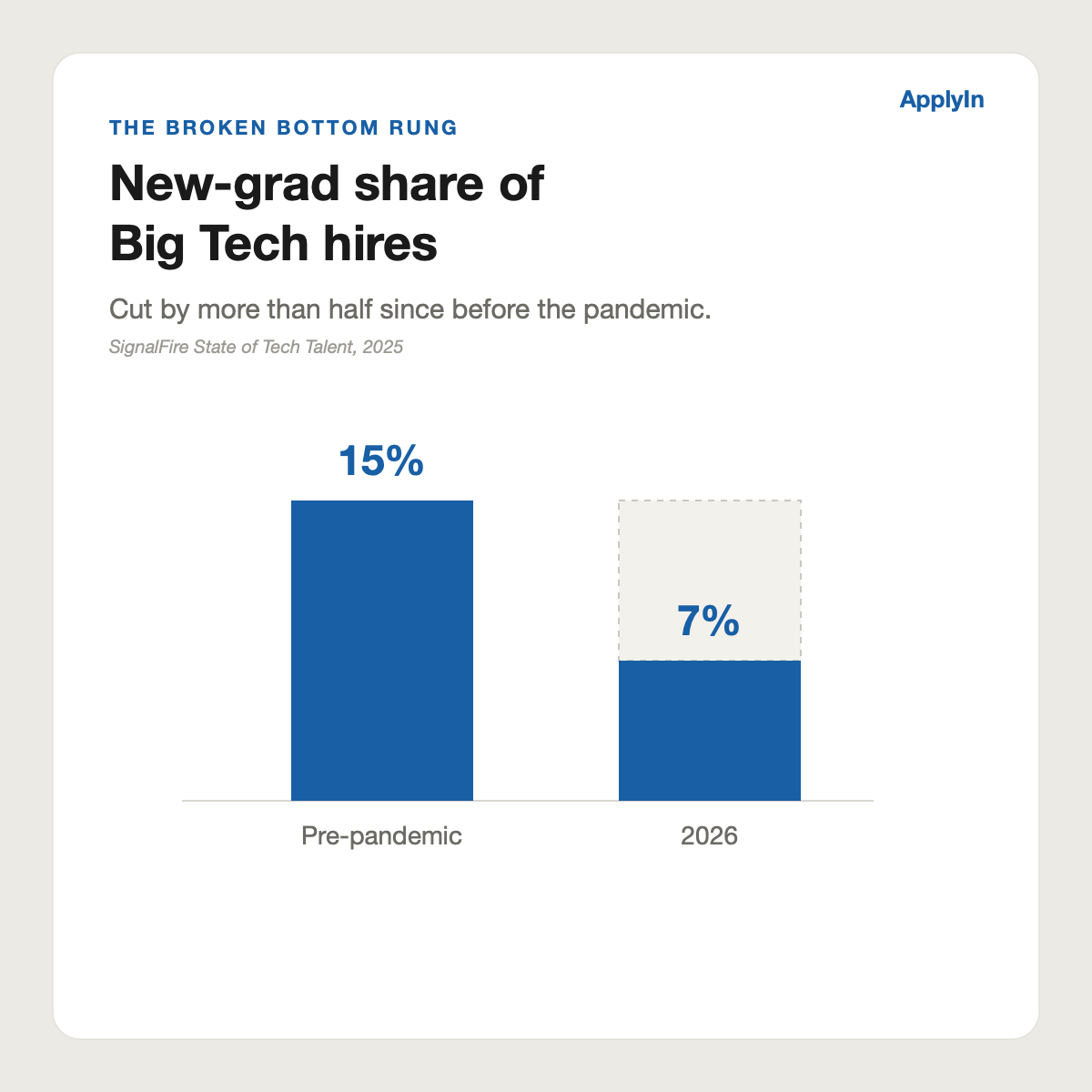
Look at where the hiring actually dried up. US postings for junior and entry-level developer roles are down roughly 40% from their pre-2022 peak, and new grads now make up only about 7% of Big Tech hires, down from 15% before the pandemic. The senior end of the market held up. The entry end fell off a cliff.
That's not a coincidence, and it's not only about layoffs. It's about what a junior engineer used to be for. The classic entry-level job was the well-specified, routine work: read the repo, write the tests, fix the boilerplate bug, ship the small multi-file pull request. It was how you earned your keep while you learned to think like an engineer.
That is precisely the work AI coding tools now do for the price of a subscription. Cursor, Claude Code, and the rest read the repo, write the tests, and produce the multi-file PR. So the economic case for hiring a row of juniors to do it weakened, and companies responded the way the math told them to: hire fewer of them, and lean on a smaller number of senior engineers who can direct the tools.
The trap nobody's pricing in
Here's the part almost nobody says out loud: if juniors can't get in, where do the next decade's seniors come from?
Senior engineers are not minted. They're grown, slowly, out of juniors who spent years doing unglamorous work, making mistakes on low-stakes tickets, and absorbing judgment from people more experienced than them. Cut off the entry point and you don't just hurt this year's new grads. You starve the pipeline that produces the very senior engineers everyone is now bidding for.
We are, in effect, optimizing entry-level roles out of existence, and we will act genuinely shocked by a "talent shortage" in five years when the supply of seasoned engineers that the bottom rung was quietly feeding never shows up. It's a textbook case of a system that's locally rational, every individual hiring decision makes sense, and globally self-defeating.
That long-term breakage is the industry's problem to reckon with. But if you're early-career today, you can't wait for the industry to fix it. You have to play the board as it actually is.
If you're early-career, change what you're proving
The losing move is to keep competing with AI on the work AI is good at. Applying to more junior reqs that barely exist, and trying to out-code a tool on routine tickets, is running straight at the part of the market that collapsed.
The winning move is to skip the rung that's missing by proving the thing the market still pays for: judgment. Concretely, that means becoming the person who directs the work rather than the one who does the routine version of it.
- Ship something real and write up the thinking. Not "I built a to-do app." Pick a project where you made an actual decision, then explain why you chose what you chose, what you traded off, and what broke. That write-up is evidence of judgment, and judgment is exactly what's scarce.
- Be the one who reviews and owns the AI's output, not the one racing it. "I use AI" isn't a skill, every applicant says it. "I can take an ambiguous problem, drive AI tools to a working solution, and vouch for the result in production" is the appreciating asset. Build that story on purpose.
- Aim where the routine-work squeeze is weakest. The regulated, consequential corners of tech still need people who can own correctness, and they're hiring while the brand-name logos cut. That's a thread worth pulling on, and I wrote about it in why fintech is the quiet hot engineering market.
None of this is fair. The door narrowed after you'd already walked through school and did everything you were told to do. That's a real, structural failure, and it is not a referendum on you. For the wider shape of how the market split, see the 2026 dev job market in detail, and for why hiring bent this way on both sides, our thesis on what broke.
The ladder lost its bottom rungs. Until the industry rebuilds them, the move for early-career engineers is to climb in higher than the market expects, by proving the judgment that used to take years of junior work to demonstrate. That's hard. It's also the most direct answer to a market that stopped buying the thing juniors used to sell.
If you're spending your nights firing applications into the void and hearing nothing, that silence is the system, not you. Pointing fewer, sharper, genuinely-matched applications at the roles that actually fit is the whole reason ApplyIn exists, so your effort lands where it can still get a human's attention.
Sources: Entry-level and junior developer posting decline (~40% off the pre-2022 peak) and new-grad share of Big Tech hiring (~7%, down from 15%), SignalFire State of Tech Talent. AI coding tools absorbing routine junior work, ApplyIn analysis of the 2026 dev hiring market. Figures move month to month; verify current numbers before relying on them.